
Brussels, 5 February 2026
Tobacco Europe provided the European Commission with its views on the customs reform: TE submission COM EU Customs Reform de minimis 26.02.05
Brussels, 20 November 2025
Tobacco Europe was pleased to take part in today’s European Parliament hearing on the revision of the Tobacco Excise Directive, organised by the FISC Committee.
We appreciated the opportunity to share our perspectives and to contribute to a lively and constructive debate with MEPs and other stakeholders. Exchanges like this are essential to ensure that the ongoing discussions around tobacco taxation are informed, balanced and reflective of the realities across Member States.
Our slides and opening statement from the hearing are available below:
Brussels, 31 October 2025
Tobacco Europe contributed to the Call for Feedback on the Tobacco Excise Directive.
Find more information on our position here: 20251030 - TE contribution to the Public Consultation on TED
21 August 2025
Statement on the Public Consultation for feedback on the review of the Tobacco Excise Directive
On 16 July 2025, the European Commission published its proposal for the revision of the Tobacco Excise Directive (TED). The proposal introduces significant changes to the existing framework, with direct implications for consumers, businesses, and public financial actors across the EU.
Five weeks after its adoption, however, the public consultation for feedback has not yet been opened. According to the Better Regulation Guidelines (SWD(2021) 305, Tool #54), stakeholders should normally be offered eight weeks to submit their views on adopted proposals. This step is a cornerstone of the EU’s transparency and inclusiveness framework, ensuring that feedback from all interested parties can inform the work of the co-legislators.
The absence of a public consultation for the TED revision is therefore inconsistent with established practice and risks undermining confidence in the EU’s commitment to transparent, predictable, and participatory policymaking.
Tobacco Europe strongly believes that:
- Public consultations are essential to ensure a balanced debate where all stakeholders — including consumers, businesses, and civil society — can share their views.
- Such consultations support accountability, as they allow stakeholders to highlight potential impacts, identify unintended consequences, and provide constructive recommendations.
- Consistency with the Better Regulation Guidance is fundamental to preserving trust in EU decision-making processes and in ensuring high-quality legislation.
For this reason, Tobacco Europe calls for the immediate opening of the public consultation on the TED revision so that the EU’s established rules on transparency and inclusiveness are respected.
On August 18, Bloomberg published an article on the revision proposal of TED, gathering views of several stakeholders including those of Tobacco Europe.
If you are interested in learning more, please reach out to : info@tobacco-europe.eu
On August 11, 2Firsts published an exclusive interview of Nathalie Darge, Tobacco Europe's Director, to gather insights on "the EU Nicotine Sector's Greatest Challenges".
Brussels, July 18,2025
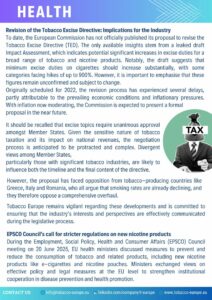
Tobacco Europe takes note of the European Commission’s proposal to revise the Tobacco Excise Directive, published on 16 July 2025. TE welcomes the effort to create greater harmonisation across the EU, notably through the establishment of separate excise categories for electronic cigarettes, heated tobacco products, and tobacco-free nicotine pouches.
However, TE has serious concerns regarding the proposed minimum rates, which we believe are set too high for both combustible tobacco and newer nicotine products. The levels suggested go beyond what is justified by consumer income evolution and economic evidence, risking unintended consequences such as reduced excise revenue and increased illicit trade, particularly in lower-income Member States.
Importantly, an excessive increase to minimum rates applied to tobacco products will substantially compromise the tax rate setting sovereignty of national governments in most Member States. This will hinder those governments from pursuing the nuanced policies required to balance revenues with other political objectives and it will impose huge price shocks on millions of consumers in the EU.
TE urges EU policymakers to consider a more balanced approach that:
- Respects Member States’ ability to tailor excise rates to local economic conditions and purchasing power;
- Applies genuine purchasing power parity adjustments rather than arbitrary formulas;
- Adopts more moderate increases in minimum rates, aligned with inflation and income growth since the last Directive update;
- Focuses on monitoring flows of raw tobacco to fight fraud, without imposing unnecessary tax burdens on semi-processed tobacco.
Tobacco Europe stands ready to engage constructively in the legislative process and remains available to support EU institutions and Member States in ensuring a fair, effective, and economically sound excise framework.







Position for the Study assessing articles 32 and 36 of the “Horizontal Directive” (2008/118/EC).
Summary
The current wording of Article 32 and the additio nal Commission’s explanatory statement already give Member States the flexibility and legal clarity they need to
effectively enforce this regulation;
The ‘Horizontal Directive’ does not provide for further product regulation s or sales restriction , but only sets out technicalities for handling these Public Health
objectives are already addressed via the ‘vertical’ Directive s (e.g. 2011/64/EU) as well as Directive 2014/40/EU
The tobacco industry has recently implemented an unprecedented Tracking & Tracing system, which provide national authorities with an efficient monitoring system;
Non domestic duty paid consumption of tobacco products is best addressed by implementing smart taxation policies.
Introduction
The Council is deciding on a recast1 of the “Horizontal Directive” (2008/118/EC), while in the meantime, the European Commission (DG TAXUD) has commissioned a study to assess whether articles 32 and 36, respectively on cross-border purchases of excise goods by private individuals and distance-selling of excise goods, can have a potential negative impact on public health.
To the best of their knowledge, ESTA and Tobacco Europe are not aware of any negative impact on public health resulting from Directive 2008/118/EC, including its articles 32 and 36. Although manufactured tobacco is associated with health risks, the Horizontal Directive only sets out the technicalities of handling and moving excise goods across the EU. It does not interfere with existing product regulation. The products, manufacturing and sale, and taxation levels are already covered by other European and national legislation, ensuring the public health objective is met (e.g. EU large and harmonised combined health warnings across the Union). The general arrangements are necessary common rules to facilitate cross-border trade as tax controls at the borders have been abolished with the establishment of the Single Market, in 1993. It should therefore be very clear that general arrangements are not to be tinkered with to address any purported negative effect resulting from diversity in tax levels.
This study should take into account that Directive 2008/118/EC is legally based on Article 113 TFEU which enables Member States to unanimously “adopt provisions for the harmonisation of legislation concerning turnover taxes, excise duties and other forms of indirect taxation to the extent that such harmonisation is necessary to ensure the European Commission, Proposal for a Council Directive laying down the general arrangements for excise duty (recast) – COM/2018/346 final, 25 May 2018. We recall that no regulatory failures associated with article 32 were identified or addressed in the REFIT Evaluation nor are mentioned in the Commission’s report to the Council and European Parliament on the implementation of the Directive.
Article 36 – Distance Selling
Article 36 sets out the administrative procedures and charging conditions for distance selling, and the current discussion on a potential one-stop-shop for excise goods aims solely at simplifying those procedures where possible. This cannot have any negative impact on public health. Directive 2014/40/EU4 sets clear requirements and conditions for distance selling of tobacco products, including registration of retail outlets, information to be provided and verifications to be conducted. This Directive also allows Member States to simply prohibit distance selling of tobacco products to consumers if deemed necessary.
Article 32 – Acquisition by private individuals
Concerning Article 32 and the concept of “personal use”, ESTA and Tobacco Europe believe that the revised wording initially proposed by the European Commission as part of the recast serves its purpose well, referring to “goods acquired by a private individual for his own use, and transported from the territory of one Member State to the territory of another Member State by the private individual”. The second paragraph provides even further guidance and criteria to determine whether goods are used for personal use or not. This gives Member States the flexibility and the legal clarity needed to effectively implement and enforce this legislation. This was further supported by the statement of the European Commission on the implementation of this article, which was annexed to the latest legislative proposal in May 20196. The statement clarifies that: “Member States may lay down guide levels, as a form of evidence as to how the goods are to be used. Quantities of excise goods below the guide levels can be assumed to be for own use. If the guide levels are exceeded, a Member State is considered to have reasonable grounds to suspect that the goods are not for own use unless it is evidenced otherwise. If it is not evidenced that the goods are for own use, excise duty shall become due in the Member State of consumption”.
As it stands, Article 32 is more appropriate and thorough than applying an “average yearly personal consumption” method as advocated by some stakeholders. Such an approach creates regulatory weaknesses whilst attempting to address a non-existent issue. Using a “yearly average” method requires to determine whether such applies per Member State or at EU level. Keeping an average up to date would also significantly increase the burden for national authorities and European legislators.
Several stakeholders have also requested to lower the minimum thresholds per product as established by the Directive, or even to set binding limits. This ignores the free circulation of goods in the EU and the very basic principles of the Internal Market, on which this Directive is based. Enforcing such additional restrictions also requires establishing stricter border controls, thereby increasing the administrative burden and cost for the national authorities.
One of the assumptions made by PwC, the consultant commissioned by DG TAXUD to assess Art 32 and 36 of the Horizontal Directive, is that the “absence of an efficient monitoring system” may conflict with health policies. Our associations would like to point out that the tobacco industry is currently implementing an unprecedented Tracking & Tracing system, which aims to enable national authorities to track any product from manufacturing to the point of sale. This system also requires each product to bear a security feature which will in practice allow authorities to determine the intended country of sale.
In more general terms, it is wrong to assume that a decrease of cross-border purchases would translate into a similar decrease of consumption. In absence of legal cheaper alternatives (i.e. cross-border purchases), price-sensitive consumers will switch to the illicit market and unregulated product, undermining the presumed health objectives. The recent London Economics Study clearly shows that taxation policy must recognise the interdependency between markets across national borders. The Study also demonstrates that when consumers are outpriced following a tax increase, illegal and counterfeited products often substitute legal domestic consumption, which presents much higher risks for public health and diminishing government revenues.
In that respect, cross-border purchases by private individuals are a better and legal alternative to illicit trade. Lowering the thresholds or establishing binding limits would therefore disrupt competition within the internal market and take away a consumers’ legal alternative to illicitly traded tobacco, thereby hindering the Directive’s objective to safeguard Member States’ fiscal revenues.
Rather than lowering national guide levels as a quick-fix solution, cross-border purchases are best addressed by implementing smart taxation policies in the Member States. As put by the European Commission in its answer to Petition N° 0645/2017 in February 20188: “Member States are perfectly aware of the excise duty rates applied by other Member States and particularly those applied in their neighbouring Member States and that they set their own excise duty rates with a view to avoiding the risk of tax losses”.
Tobacco Europe (formerly The Confederation of European Cigarette Manufacturers – CECCM) represents the common views of major European–based cigarette manufacturers such as British American Tobacco (BAT), Imperial Brands (IMB), and Japan Tobacco International (JTI).
The classification of e-cigarettes in the 2022 WCO Harmonized Commodity Description and Coding System
The Confederation of European Community Cigarette Manufacturers (CECCM) urges EU Member States to: • support only those proposals for creating new headings and subheadings in the WCO HS2022 classification that make a clear distinction between e-cigarettes (which do not contain tobacco) and tobacco products; • continue to support the WCO/WHO classification proposal which does make such a distinction; and • oppose the WCO Secretariat proposal which would classify the liquids used with e-cigarettes and certain tobacco products very closely together.
At the next World Customs Organization (WCO) Harmonized System Committee (HSC) meeting in March 2019, the WCO Secretariat’s proposal for the new Chapter 24 title, headings and subheadings will be discussed.
The European Commission seeks a mandate for this meeting from the EU Member States on the 25th of January in the EU Customs Union Working Party.
The Commission’s preferred option is to support the WCO/WHO proposal.
However, the Commission also recognises that the WCO Secretariat’s intention is to discuss only its own proposal at the HSC meeting and for the WCO/WHO proposal to not be considered. In order to not block the decision-making process, the Commission has suggested that the EU Member States should agree to the proposal put forward by the WCO Secretariat, even though it is, in their opinion, an inferior option.
The WCO Secretariat’s intention that only its proposal will be discussed is despite a continued lack of consensus between the WCO’s contracting parties:
• In the September 2018 HSC meeting, the WCO Secretariat proposal received 53% of the total votes cast, only marginally more than the support for the WHO / WCO Secretariat’s joint proposal.
• At the Review Sub-Committee (RSC) in November 2018, several contracting parties continued to object to the WCO Secretariat’s proposal, spoke in favour of other proposals, and no consensus was reached.
The WCO Secretariat’s proposal would:
• move the liquids used with e-cigarettes into Chapter 24 of the HS that deals with tobacco products; and
• classify e-liquids (2404.12) under the same heading as products intended for inhalation without combustion that contain tobacco (2404.11).
The new headings and subheadings being proposed by the WCO Secretariat pose serious concerns for the e-cigarette industry and for public health.
A range of taxes on e-cigarette products are significantly affected by their customs classification. Import tariffs are determined directly by a product’s customs coding. And, as the WCO acknowledges, national taxes, such as excise duties, are also influenced by a product’s customs classification.
Classifying products containing tobacco and products not containing tobacco under the same heading – as in the WCO Secretariat’s proposal – may be seen as an endorsement for an increase in import duties and excise on e-cigarettes, as well as the harmonization of regulation between e-cigarettes (which contain no tobacco) and tobacco products.
This could damage the sale of e-cigarette products, undermine the international trade in them and have negative effects for public health. The main purpose of the WCO’s classification system is to facilitate international trade in products. In fact, it risks doing the precise opposite for e-cigarettes.
The WCO Secretariat’s proposal would also be inconsistent with a significant, and growing, body of evidence from independent experts1 that e-cigarettes are potentially significantly less harmful than combustible tobacco. Many influential studies have concluded that e-cigarettes are only 5% (or less) as harmful as smoking tobacco.
Because of the emerging evidence on their potential harm reduction compared to combustible tobacco products, a number of high-profile governmental reviews have recently called for a different treatment of e-cigarette tax and regulation from tobacco products:
• In an ongoing review of the European Union’s Council Directive 2011/64/EU, which defines the product categories, structure and minimum rates for excise duties on manufactured tobacco in the EU, responses received by the European Commission show a clear consensus that e-cigarettes should not be taxed like tobacco products. Out of the total 11,410 responses submitted to the consultation2: 88% of respondents agreed that e-cigarettes are much less harmful than conventional tobacco products; 85% agreed that e-cigarettes may support smoking cessation; 77% disagreed that e-cigarettes should be subject to the same excise treatment as conventional cigarettes; and 87% agreed that e-cigarettes are not tobacco products so should not be subject to tobacco excise legislation.
• A Command Paper published in December 2018 by the UK’s Secretary of State for Health and Social Care3 confirms the government’s firm belief in the reduced risk profile of e-cigarettes and calls for proportionate regulation of e-cigarettes based on the reduced risk profile of these devices. Recommendation 6 of the Command Paper endorses the UK’s current practice of treating e-cigarettes as consumer products for taxation purposes, subject only to the 20% Value Added Tax.
• Adopting the WCO Secretariat’s proposal in its current form would contradict discussions that took place in October 2018 at the eighth Conference of the Parties (COP8) to discuss the WHO Framework Convention on Tobacco Control (FCTC). The FCTC is a treaty signed by 168 countries, legally binding in 181 countries, and for all intents and purposes serves as the global blueprint for tobacco regulation. The parties to the treaty agree that heated tobacco products are covered under the auspices of the FCTC. But attempts to bring e-cigarettes under the umbrella of the convention were rejected at COP8. It would be inappropriate to classify e-cigarettes closely together with tobacco products in the customs classification system before any agreement is reached on their global regulatory treatment under the FCTC.
Additionally, in a 2016 case, the Court of Justice of the European Union ruled that: “… electronic cigarettes display different objective characteristics from those of tobacco products.4” This ruling was reiterated in the Court of Justice of the European Union’s judgement in November 20185. Therefore, two recent judgements by the EU’s most senior court confirmed that the objective characteristics of e-cigarettes are different, in law, to those of tobacco products. It would be anomalous for the customs classification of e-cigarettes to be similar to those of any tobacco product.
It is important that the decisions made by customs authorities do not contradict the approach by other government departments at both a national and international level. If the WCO Secretariat’s proposal was adopted in its existing form, it would clearly do so.
Moreover, another important purpose of the HS is: “… to promote as close a correlation as possible between import and export trade statistics and production statistics …”6 Should the WCO Secretariat’s proposal be adopted in its current form, production statistics for heading 24.04 would be flawed insofar as they would include both products that contain tobacco and products that contain no tobacco.
1 See Public Health England (PHE) report at https://www.gov.uk/government/publications/e-cigarettes-and-heated-tobacco-products-evidence-review
See Royal College of Physicians’ report at https://www.rcplondon.ac.uk/news/promote-e-cigarettes-widely-substitute-smoking-says-new-rcp-report
2 See https://circabc.europa.eu/sd/a/e6a09ea7-1c96-4d2b-9e53-ff10bef7be94/Tobacco%20public%20consultation%202018%20statistical%20report.pdf and https://circabc.europa.eu/faces/jsp/extension/wai/navigation/container.jsp
3 See https://assets.publishing.service.gov.uk/government/uploads/ system/uploads/attachment_data/file/762847/government-response-to-science-and-technology-committee_s-report-on-e-cig.pdf and https://vaporproductstax.com/2019/01/02/government-supports-taxation/
4 Case C-477/14, Pillbox 38 (UK) Limited, trading as Totally Wicked v Secretary of State for Health, ECLI:EU:C:2016:324, para. 36, http://curia.europa.eu/juris/document/document.jsf?text=&docid=177723&pageIndex=0&doclang=EN&mode=lst&dir=&occ=first&part=1&cid=6455726
5 Case C 151/17, Swedish Match AB v Secretary of State for Health, ECLI:EU:C:2018:938, para. 29, http://curia.europa.eu/juris/document/document.jsf?text=&docid=207969&pageIndex=0&doclang=EN&mode=lst&dir=&occ=first&part=1&cid=6473289
6 http://www.wcoomd.org/en/topics/nomenclature/instrument-and-tools/hs_convention.aspx
In summary, an inappropriate customs tariff classification of e-cigarette products risks the unintended consequences of damaging the international trade in them. There is, in stark contrast, absolutely no downside to either the WCO or to individual customs departments from a much clearer separation of e-cigarettes from tobacco in the customs system.
Furthermore, introducing no further changes to the HS, by retaining the status quo, would be a preferable option to the WCO Secretariat’s proposal. This would avoid the risk of e-cigarettes being unduly regulated and taxed like tobacco products in certain countries.
If this cannot be achieved, the mandate for the Commission should be broad enough to capture changes to the WCO Secretariat proposal that would allow amendments that are more in line with the WCO/WHO proposal.
Recast of the Council the Directive 2008/118/EC concerning the general arrangements for excise duty
CECCM Position paper
CECCM1 welcomes the Commission’s proposal on the recast of the Council the Directive 2008/118/EC concerning the general arrangements for excise duty published by the Commission on 25 May 2018.
Together with its members, CECCM would like to suggest some amendments, notably in view of the upcoming Council meeting (Working Party on Tax Questions) due to be held on 9 November that will focus, among other issues, on this Recast Directive.
In general, CECCM supports Commission’s view that export followed by external transit should be allowed for excise goods, starting with the solutions put forward to further harmonize excise and customs procedures (both on the import and export sides). However, there’ s a need to ensure that the principles of internal market are properly reflected, notably in the case of refund procedures following the destruction of goods or tax markings under customs supervision. Furthermore, there’s a need to clarify that tax stamps should not trigger excise liability if not used in production or if the goods are not made available to the consumer, as an excise tax is first and foremost a tax on consumption.
CECCM also calls on the introduction of a harmonised “Right to be heard” for economic operators, in accordance with the Union Customs Code. Currently, national jurisdictions provide some recourse when adverse decisions are made but the ease of challenging such decisions in the field of excise varies greatly across the EU. The “right to be heard”, which is already established in the European Customs Code, states that a person or an economic operator has a right to be heard whenever customs authorities “intend to take a decision that would adversely affect the person to whom the decision is addressed”. This suggestion would notably reflect the Impact Assessment for the revision of Directive 2008/118/EC which clearly demonstrated that harmonising the “right to be heard” would have significant benefits for both economic operators and national administrations, especially in terms or suspected shortages or excesses.
Regarding guarantees, CECCM believes some improvements should be made, particularly on the need to ensure a mutual recognition for guarantees in the EU. Too many Member States still requires operators to lodge the guarantee in a financial institution established on its own territory. This substantially increases the administrative burden and ignores the principles of the internal market and free movement of goods and capital. In light of this, from an internal market perspective, there should be an option to have a guarantee in one Member State that would apply to all other Member States.
On the new definitions introduced by the Commission with regard to a ‘certified consignor’ and ‘certified consignee’, these should be further clarified by adding “for commercial purpose” to avoid any potential interpretation inconsistencies in relation to other movement regulations applying to duty-paid goods.
Moreover, CECCM would suggest maintaining the original terminology “holding” used by the Commission, instead of the new wording “processing and storage”, as this will restrict the scope of entities engaging in illegal activities that tax authorities will be able to pursue (as, most frequently the criminal activities are based on informal, non-legalized arrangements) by setting a “higher standard” for them – tax authorities would need to prove that the persons engaged in criminal activities were processing the goods or storing them not only holding them or transporting them.
1 CECCM represents the common views of major European–based cigarette manufacturers such as British American Tobacco (BAT), Imperial Brands (IMB), and Japan Tobacco International (JTI).
On excise refund, CECCM considers that mutual recognition of tax stamps destruction by government officials should be promoted at EU level to reduce the administrative burden for economic operators. Refund procedure should exist for excise goods which are returned / withdrawn from the market after their release for consumption due to quality issues. Importantly, tax stamps that have not been used in production should not trigger excise liability given that the excise goods have not been released for consumption.
CECCM suggests enabling economic operators to correct common typing errors before the movement ends and after the unique administrative reference code has been assigned, thus allowing electronic documents to be amended under supervision of the customs authorities, before the movement give rise to irregularities and unjustified duties. Additionally, in the case the economic operator is able to provide sufficient evidence that goods under duty suspension subject to an irregularity during the movement are held in the tax warehouse, or have left the territory of the Union, excise duties should not be levied. Both suggestions will reduce the administrative burden of economic operators.
Last but not least on the interactions between excise and customs, movements of excise goods to and from special fiscal territories should be facilitated, as according to the Directive they should be considered “exports” for excise purposes and the provisions related to export should apply mutatis mutandis. In practice, using the export procedures for excise goods means that the electronic administrative document would be always closed or confirmed in the Member State of dispatch, based on the confirmation of exit for export purposes. The customs documents would also reflect the EMCS documents for excise goods enabling control during the movement within the territory of the Union.
In annex, you will find a list of detailed amendments, reflecting our above-mentioned comments, for your information.
We express our availability to fully cooperate with all the stakeholders involved in the process of the recast of the Council Directive 2008/118/EC and kindly invite you to contact us should you need any further information.
CECCM’s official response to the European Commission’s consultation on excise duties applied to manufactured tobacco and the possible taxation of novel products.
Official Contribution CECCM PC Excise 29.08.18
CECCM ANNEX Public Consultation Excise 27.08.18
THE CUSTOMS CLASSIFICATION OF TOBACCO HEATING PRODUCT CONSUMABLES AND THE CHEMICAL PREPARATIONS USED IN ENDS IN THE WCO’S HARMONIZED SYSTEM TARIFF NOMENCLATURE
Please find attached a CECCM paper, prepared in advnace of the Harmonized System Committee’s (HSC) 62nd Session meeting on 17th – 28th September 2018 to discuss the customs classification in the Harmonized System (HS) nomenclature for implementation in 2022 of:
a. tobacco used with Tobacco Heating Products (THPs); and
b. the chemical preparations used for e-cigarettes or electronic nicotine delivery systems (often called ‘e-liquids’).
The HSC has been invited to discuss the following four proposals on “Possible amendments to the nomenclature to create a new heading for nicotine products and novel tobacco products”:
CECCM opinion on WCO HSC-RSC options 23.08.18
CECCM position paper on the recast of the Council Directive 2008/118/EC concerning the general arrangements for excise duty
CECCM’s position reflects the views of its member companies, namely British American Tobacco (BAT), Japan Tobacco International (JTI) and Imperial Brands (IMB).
CECCM welcomes the proposal for the recast of the Council Directive 2008/118/EC concerning the general arrangements for excise duty (hereinafter referred to as “Horizontal Directive”) made by the Commission, starting with the alignment between the terminology used by the Excise Directive and the Union Customs Code (UCC) as well as the solutions put forward to further harmonize excise and customs procedures (both on the import and export sides) among which:
• Automated interface between EMCS (Excise Movement and Control System) and AES (Automated Export System);
• Automated data cross-check between electronic excise and customs systems;
• Common list of alternative proofs of exit;
• Common requirements for duty exemptions at import.
On excise and customs interactions topic, we concur with Commission’s view that export followed by external transit should be allowed for excise goods.
Interactions between excise and customs could also be covering deliveries of excise goods to special fiscal territories (e.g. Canary Islands), which are considered part of the customs territory of the EU, but which are currently not in scope of the Horizontal Directive.
On duty paid Business to Business procedures, CECCM welcomes the extension of EMCS to cover cross border duty paid movements.
About exceptional situations such as shortages, excesses, rejections or interruptions, CECCM regrets the Commission’s decision not to suggest a common approach in the proposal, but to leave this to a delegated act. If this would remain the case, CECCM believes the delegated act should be proportionate and designed in consultation with relevant stakeholders.
Furthermore, with regards to the right to be heard for economic operators, CECCM also regrets no harmonized approach has been proposed. However, CECCM supports the usage of EMCS data as input to recovery instruments.
Together with its members, CECCM considers that the revised Directive 2008/118/EC should contain new provisions that would allow the Member State of dispatch to reimburse or remit excise where there is evidence that the relevant goods, involved in a discrepancy, are held in an excise warehouse in the Member State of destination or have left the territory of the European Union.
Regarding guarantees, CECCM believes that the EU Commission has missed the opportunity to improve and simplify the legal framework, more precisely to allow for alternative instruments in lieu of traditional means of guarantees (e.g. promissory note) and for taking into consideration the internal market aspects (e.g. by ensuring mutual recognition of guarantees to be provided by a financial institution in any EU country).
CECCM – Confederation of European Community Cigarette Manufacturers
Avenue Louise, 375
B- 1050 Brussels
ceccm@ceccm.eu – Registered number 089 438 919
Also, in case guarantees are required for tax stamps, tolerance should be permitted allowing tax stamps to exceed the guarantee.
Finally, on excise refund, CECCM considers that mutual recognition of tax stamps destruction by government officials should be promoted at EU level to reduce the administrative burden for economic operators. Refund procedure should exist for excise goods which are returned / withdrawn from the market after their release for consumption due to quality issues. Importantly, tax stamps that have not been used in production should not trigger excise liability given that the excise goods have not been released for consumption.
Last but not least, CECCM would welcome a specific clause in the revised Directive on a refund procedure for excise goods in case those goods are withdrawn (or returned) from the market after having been released for consumption.
We are looking forward to a continued fruitful collaboration and in the meantime, we remain at your disposal for any further clarification you may need.
24/05/18
CECCM1 Briefing note: the Eko-Tabak judgment and the smoking test provided by the CN Explanatory notes
1. CECCM concerns over diverging interpretations following Eko-Tabak judgment
A. The Judgment on Case C-638/15 – Eko-Tabak vs. General Directorate of Customs, Czech Republic
The Court of Justice of the European Union (CJEU) delivered its judgment on 6 April 2017 (here) relating to a request for preliminary ruling on the interpretation of Articles 2 & 5 of Directive 2011/64/EU (“Excise Directive”) on the definition of smoking tobacco.
In this preliminary ruling, the CJEU ruled that Articles 2 and 5 of the Excise Directive “must be interpreted as meaning that dried, flat, irregular, partly stripped leaf tobacco and/or parts thereof which have undergone primary drying and controlled dampening, which contain glycerine and which are capable of being smoked after simple processing by means of crushing or hand-cutting, fall within the definition of ‘smoking tobacco’ for the purpose of those provisions”.
In addition, the CJEU quoted the definition of “smoking tobacco” in the context of the Excise Directive as “tobacco which has been cut or otherwise split, twisted or pressed into blocks and is capable of being smoked without further industrial processing”.
Taking together the definition in the Excise Directive2 and the operative part of the CJEU judgment, “smoking tobacco” may only be understood as a product that fulfils the following two cumulative conditions:
1. “That the tobacco be cut or otherwise split, twisted or pressed into blocks”;
2. “That it is capable of being smoked without further industrial processing”
The CJEU clarified when tobacco may be regarded as being cut and otherwise split in the context of the first condition.3
With reference to the second condition, it is important to note that the CJEU found that this condition is satisfied when tobacco products have undergone primary drying and controlled dampening, contain glycerine and are capable of being smoked after simple processing by means of crushing or hand-cutting. Tobacco raw materials do not contain glycerine which is usually added during manufacturing process of semi-finished or final tobacco products.
With regard to the concept of “industrial processing” the CJEU concluded that “manufactured tobacco which is ready or can easily be made ready [after simple processing by means of crushing or hand-cutting] to be smoked must be considered to be capable of being smoked without further industrial processing”. Industrial processing, on another hand, takes place in the designated premises using specialized machinery.
1 Confederation of European Community Cigarette Manufacturers, representing British American Tobacco (BAT), Imperial Tobacco Brands (IMB) and Japan Tobacco International (JTI).
2 See Case C-638/15, Eko-Tabak, ECLI:EU:C:2017:277, para. 25, which focuses on the two cumulative conditions found in the Excise Directive.
3 Case C-638/15, Eko-Tabak, ECLI:EU:C:2017:277, para. 28 of the judgment: “[…] in so far as the products […] consist […] of tobacco leaves which have been partly stripped in order to remove the petiole, those products must be regarded as tobacco which has been cut or otherwise split within the meaning of Article 5(1)(a) of Directive 2011/64”.
Further, an important fact in the CJEU’s analysis (and under the relevant Czech law) is that the smoking tobacco was “prepared for sale to the final consumer”.4 The judgment is designed to respond to a specific illicit trade activity (tax evasion) by the Czech company. In fact, the company provided the smoking tobacco for sale to final consumers yet illegitimately claimed that it was raw tobacco in its failed attempt to escape payment of the excise duty on smoking tobacco under the Excise Directive. As the CJEU states, “[…] those products were, in their entirety, intended for sale to the final consumer”5. This is further supported by the Czech court which noted that the smoking tobacco was offered to final consumers who were even able to avail themselves of a leaf cutting machine on the counter of the shop6.
The Eko-Tabak judgment sets the guidance to counter a clearly illicit activity which is different from legitimate movement by economic operators of raw tobacco that is destined and in fact is used to manufacture finished tobacco products (which are then subject to relevant excise tax and VAT).
Considering the above, the authorities of the Member States have now sufficient guidance and grounds to levy excise duty when cut and split tobacco is destined for sale to final consumers.
Unfortunately, we notice that the judgment is misused in day-to-day practice by the authorities of some Member States who generally consider raw tobacco (not destined for sale to final consumer but for further processing in authorized tobacco manufacturing plants) as subject to excise based upon the provisions of the Article 5(1)(a) of the Excise Directive. With the following, we give a couple of examples and explain the practical consequences for the member companies of CECCM.
B. Different issues CECCM Members face in EU Member States
1. Germany
In September 2017, the Ministry of Finance issued guidelines to all German Main Customs Offices to ensure a common approach in assessing shipments of tobacco falling under the category of (other) smoking tobacco in line with the provisions of the German Tobacco Tax Law.
As a direct consequence, the number of the physical controls increased on the shipments of raw tobacco, with the authorities taking samples of the tobacco and seizing / confiscating the cargo in certain cases.
On 28 February 2018, the German Ministry of Finance also informed the main national tobacco trade federations (Deutscher Zigarettenverband, Verband der Rauchindustrie and Bundesverband der Zigarrenindustrie) that they will interpret the terms “smoking tobacco” very broadly. In fact, going forward, they will treat any tobacco that is somehow broken, cut or split as being capable of being smoked without further industrial processing which consequently means that these products are going to be treated as excisable.
This interpretation overlooks several phases of industrial processing other than “cutting or otherwise splitting” such as, inter alia, the necessary addition of glycerine in smoking tobacco, as recognized by the CJEU in the operative part of its Eko-Tabak judgment, and it creates obstacles to the free movement of goods to other EU countries where these goods are rightly considered as non-excisable and are generally subject to national monitoring measures.
4 Case C-638/15, Eko-Tabak, ECLI:EU:C:2017:277, para. 7, 8, 15.
5 Case C-638/15, Eko-Tabak, ECLI:EU:C:2017:277, para. 8.
6 Eko-Tabak, s. r. o. vs. Generální ředitelství cel (General Customs Directorate), Nejvyšší správní soud (Supreme Administrative Court, Czech Republic), Brno, 24 August 2017, paras. 8, 37.
2. Sweden
Sweden has faced during recent years a growing issue with raw tobacco sold at retail. The Eko-Tabak judgment provided the basis to tackle this issue; however, the manner chosen by the local authorities harmed the legitimate snus producers also.
For instance, a snus7 producer had its tobacco scrutinized and, although the customs classification under 2401 heading was upheld, some of the tobacco materials were considered as being subject to excise because Swedish Customs believed that they could be smoked without further industrial processing.
2. CECCM’s views on the use of the smoking test to classify products for excise purposes
When it comes to customs and the import of goods into the EU, the Common Customs Tariff applies, which represents a combination of the classification of goods for customs purposes and the duty rates that apply depending on the economic sensitivity of the products.
Classification of the goods for customs purposes is determined based on the Combined Nomenclature (“CN”) of the European Union which itself is based upon the Harmonized System (“HS”), a coding system for commodities which is applied by most of the trading nations around the globe, under the auspices of the World Customs Organization. Application of the CN is supported by Explanatory Notes to the HS and to the CN8, which provide guidance on the classification of products.
On the 6th of April 2016, an amendment to the CN has been published in the Official Journal of the EU, providing for a smoking test designed to distinguish between manufactured tobacco of heading 2403 and unmanufactured tobacco of heading 2401.
CECCM would like to express deepest concerns regarding whether or not the smoking test for tobacco and tobacco products should be used when determining if a certain tobacco material is capable of being smoked or can be smoked, in the meaning of Article 5 of the Excise Directive.
As expressed on earlier occasions, we regard the smoking test as unsatisfactory in its current form and welcome the opportunity to have it reviewed and refined. In this particular case, the smoking test may be used in practice to classify tobacco products as excise goods in breach of the definitions of the Excise Directive. This is done because the MS authorities may regard it as the only scientific tool available to indicate whether tobacco and tobacco products are ready for smoking without any further industrial processing.
An example of where the smoking test has been used to determine excisability is Sweden.
Swedish Customs detained five containers of raw tobacco for use in the snus factory of one of CECCM’s members in August 2017. The purpose of this detainment was to take samples and determine if the tobacco fell within the description of smoking tobacco and should thus be
7 A type of moist powdered tobacco, held in the mouth between the lips and gums.
8 Explanatory notes to the Combined Nomenclature of the European Union, Official Journal of the European Union, C 76, 04.03.2015.
classified under a different customs tariff heading subject to a customs duty rate of 74.9%. We believe the motivation behind this unreasonable change in customs classification purposes derives from misapplication of the “smoking test” referred to in the CN Explanatory Notes.
Upon examination, three of the containers were found by Swedish Customs to contain goods determined to be classifiable as raw tobacco. Two containers, however, were found to allegedly contain material determined to be classified as smoking tobacco of heading 2403. Aside from the higher rate of customs duty, Swedish
Customs determined that because of the customs classification of “smoking tobacco” it was also considered appropriate that the goods should be subject to excise duty and accordingly subject to associated excise controls.
Advocate General Kokott has already established that, in order to assess whether or not tobacco goods are covered by the Council Directive 2011/64/EU (the Excise Directive) and are therefore liable to excise duty, “the determinative element is not the Combined Nomenclature, but Directive 2011/649”.
3. Conclusion
All in all, it is important to note that the EU Commission, in its January 2018 report on the review of a possible revision of Directive 2011/64 opposed the application of excise duties to raw tobacco as a measure to fight illicit trade10. Application of a smoking test designed for customs classification purposes to determine that excise tax should allegedly be applied to raw tobacco meant for manufacture into finished goods is clearly against the Commission’s recent guidance on this matter.
Importantly, as highlighted in the key findings of Economisti Associati study11, illicit trade of raw tobacco in the EU is estimated in a range between 0.8% to 1.2% of the EU raw tobacco market, and lost revenues on the amount of cigarettes which can be produced with illicit raw tobacco would amount to €1.2 to 2 bn (that is 1.6% to 2.7% of the current revenues from cigarettes).
Administrative and compliance costs for growers and first processors are expected to be significant and would represent a cost increase of 35% compared to the current price of raw tobacco. With respect to the EU raw tobacco market, additional regulatory costs would amount to 8% of its value. Therefore, the inclusion of raw tobacco among excisable products seems to be a disproportionate response, given the amount of costs associated.
4. CECCM’s suggestions to the Member States
In the light of all the above, we therefore respectfully suggest to the Member States:
1. To properly apply the two cumulative conditions outlined in EU law and discussed above (and not to rely on customs classification rules) when analysing whether some tobacco products are “smoking tobacco” for excise purposes.
2. To consider the Eko-tabak judgment in its context, which was to tackle the abuse of the system (intentional misdeclaration by a manufacturer of goods that were manufactured and prepared for retail sales; i.e. as unmanufactured tobacco to evade excise duties). In particular, the industrial processing of primary drying, controlled dampening and addition of glycerine should be given due relevance in such analysis.
9 Opinion of Advocate General Kokott in Case C-409/14, Schenker, ECLI:EU:C:2016:76 para 82.
10 Report from the Commission to the Council on Directive 2011/64/EU on the structure and rates of excise duty applied to manufactured tobacco, COM(2018) 17 final, Brussels, 12.1.2018, pp. 4-5.
11 Economisti Associati Study on Council Directive 2011/64/EU on the structure and rates of excise duty applied to manufactured tobacco, Final Report, May 2017, p.163.
3. To avoid unnecessary complexity to enforcement of excise legislation as well as the legitimate manufacturing processes.
4. To properly enforce the existing legislation – this approach would solve many issues (e.g. direct sales at retail with machines in shops to cut the tobacco or instructions how to do it at home).
5. In case increased monitoring of the supply chain would be desired, to consider an alternative which is more efficient than the inclusion of unmanufactured tobacco under EMCS, i.e. a licensing system at Member State level. Such systems are currently successfully applied in Denmark, Ireland, the UK, Czech Republic, Poland and Romania – and have solved the local problems by penalising those involved in the handling of unmanufactured tobacco outside the licensing system.
Please see the attached presentation prepared for a meeting with DG Taxud, 10 April 2018:
CECCM Eko-Tabak_Smoking Test 10.04.18
THE APPROPRIATE CUSTOMS CLASSIFICATION IN THE WCO’S HARMONIZED SYSTEM TARIFF NOMENCLATURE OF TOBACCO HEATING PRODUCT CONSUMABLES AND THE CHEMICAL PREPARATIONS USED IN ENDS SUMMARY OF PROPOSED NEW HEADINGS AND SUB-HEADINGS FOR THE CLASSIFICATION OF THP CONSUMABLES AND CHEMICAL PREPARATIONS USED IN ENDS
• Tobacco Heating Products (THPs) heat tobacco, but do not combust it, to produce a nicotine-containing aerosol.
• Electronic nicotine delivery systems (ENDS) heat a chemical preparation (often, but not always, in liquid form, known as an ‘e-liquid’), to create an aerosol which is fundamentally different in its physical composition to both tobacco smoke and to the aerosol created by THPs. Although some chemicals in e-liquids, including nicotine and some soluble flavourings, may be derived from tobacco, e-liquids do not contain tobacco.
• The WCO’s Review Sub-Committee (RSC) is currently considering several proposals for creating new headings or subheadings for both THPs and e-liquids under the Harmonized System Tariff Nomenclature (the HS) in the year 2022. These proposals are flawed because they are inconsistent with the fundamental principle by which products are classified for customs purposes based on their essential physical characteristics.
• The Confederation of European Community Cigarette Manufacturers (CECCM) and its members1 propose that THPs should be classified in the HS under a new subheading 2403.92 as follows:
2403.92 Tobacco products for heated delivery without combustion
• CECCM proposes that the chemical preparations used with ENDS, including e-liquids, should be classified in the HS under a new 4-digit level heading 38.27:
38.27 Chemical preparations, whether or not containing nicotine or flavouring substances and whether or not contained in bottles or special cartridges or capsules, for use with electronic devices heating these preparations without combustion in order to produce an aerosol:
3827.10 – containing nicotine
3827.20 – not containing nicotine
• It would not be appropriate for the chemical preparations used with ENDS to be treated in the same way as THPs in regulation, excise or customs classification. THPs are tobacco products, whereas the chemical preparations used in ENDS contain no tobacco – they are fundamentally different in their essential physical composition.
• These proposed new headings / subheadings adhere to the fundamental principles by which products are classified for customs purposes based on their essential physical characteristics. They maintain simplicity within the existing system. And they will allow the WCO and its contracting parties to achieve all the stated objectives of the HS: to facilitate international trade; to facilitate the collection, comparison and analysis of trade statistics; and to promote the standardisation of trade documentation and the transmission of data.
1 CECCM represents the common views of major European–based cigarette manufacturers such as British American Tobacco (BAT), Imperial Brands (IMB), and Japan Tobacco International (JTI).
DEFINITION OF TOBACCO HEATING PRODUCTS AND ENDS
• Tobacco Heating Products (THPs) are products in which the tobacco is heated rather than combusted to produce a nicotine-containing aerosol.
o THPs contain tobacco – they are different to electronic cigarettes which do not contain tobacco.
o Several types of THP are currently sold across a range of countries. The most widely available THPs are electrically heated tobacco products. Also available in some countries are: THPs that heat a tobacco rod using a lit carbon tip; and hybrid products that heat an e-liquid to create an aerosol that, when passed over a tobacco pod, heats the tobacco to provide additional flavours and nicotine.
o The category is rapidly evolving, and it seems likely that other types THPs will be developed in the future. However, the common feature amongst all THPs will remain that they heat tobacco and do not combust it.
• Electronic nicotine delivery systems (ENDS) are comprised of two elements:
o First, a chemical preparation, often in liquid form known as an ‘e-liquid’. Although some chemicals in the chemical preparations used in ENDS, including nicotine and soluble flavourings, may be derived from tobacco, they do not contain tobacco.
o Second, an electronic device which heats the chemical preparation to create an aerosol which is fundamentally different in its physical composition to tobacco smoke. THE CURRENT CLASSIFICATION OF TOBACCO HEATING PRODUCTS AND THE CHEMICAL PREPARATIONS USED IN ENDS
• THP consumables, as a tobacco product, are classified in Chapter 24 of the HS (“Tobacco and Manufactured Tobacco Substitutes”). In October 2017, the WCO Harmonized System Committee (HSC) considered the appropriate classification of Electrically Heated Tobacco Product (EHTP) consumables in the 2017 HS. A large majority of contracting parties voted for classification of these products in subheading 2403.99.
• In September 2011, the HSC agreed that cartridges for ENDS “whether or not containing nicotine, could not be regarded as tobacco substitutes.” Consequently, it decided to classify them under heading 38.24 of the HS (in the chapter covering “Miscellaneous Chemical Products”). TOBACCO HEATING PRODUCTS MUST BE
CLASSIFIED IN CHAPTER 24 OF THE HS AND THE CHEMICAL PREPARATIONS USED IN ENDS MUST BE CLASSIFIED IN CHAPTER 38
• For customs classification, two criteria must be considered.
o First, the essential physical characteristics of the product.
o Second, in some cases, their intended use.
• The consumables used with tobacco heating products should continue to be classified under a subheading in 2403.9 of the HS nomenclature (under which there is currently 2403.912 or 2403.993).
o THPs contain tobacco, so it follows that they must be classified in Chapter 24 of the HS, covering “Tobacco and manufactured tobacco substitutes”.
2 “Homogenised” or “reconstituted tobacco”.
3 Other manufactured tobacco that is not intended for smoking.
o The WCO Secretariat has indicated that two factors are relevant to defining the essential characteristics of the consumables used with electrically heated tobacco products (EHTPs). First, the tobacco used in these products is entirely reconstituted tobacco (combustible tobacco products contain much smaller amounts of reconstituted tobacco). Second, the product’s intended use is not to be smoked. The WCO Secretariat stated that if Contracting Parties accept these as the defining essential physical characteristics of EHTP consumables, they should not be classified under the same subheadings as combustible tobacco (i.e. under either heading 24.024, or under subheadings 2403.115 or 2403.196, all of which are for types of smoking tobacco).
o Moreover, EHTPs cannot be classified under heading 24.01, which covers unmanufactured tobacco.
o It follows that EHTPs must be classified in the part of heading 24.03 that covers finished tobacco products that are not intended for smoking.
• The chemical preparations used in ENDS, including e-liquids, should continue to be classified under Chapter 38 of the HS nomenclature.
o The chemical preparations used in ENDS, including e-liquids, exhibit profound differences in their material composition and physical characteristics to the tobacco products that are classified under Chapter 24 of the HS2017.
o Since e-liquids (and other chemical preparations used in ENDS) are chemical solutions which, even when partly derived from a tobacco plant, contain no tobacco, they must continue to be classified in HS Chapter 38 (“Miscellaneous chemical products”).
o And because ENDS cartridges / liquids do not display similar physical characteristics to tobacco products, the chemical preparations used in ENDS should not be classified in the same chapter of the HS as tobacco products.
o Please see Appendix 1 for a legal opinion that provides further background.
PROPOSAL FOR NEW SUBHEADINGS FOR TOBACCO HEATING PRODUCT CONSUMABLES IN CHAPTER 24 OF THE HS IN THE YEAR 2022
• Our proposal for the customs classification of THP consumables in the HS is to create a new subheading 2403.92.
• This approach has several practical benefits:
o It is wholly consistent with the general principles by which products are classified in the HS according to their essential physical characteristics.
o It is consistent with the recent guidance from the WCO Secretariat regarding the essential characteristics of EHTP consumables.
o It is commensurate with the likely scale of global trade in THP consumables relative to other tobacco products. Notably, since cigarettes containing tobacco are classified under a subheading (2402.20) and do not have their own 4-digit heading, it would seem inappropriate for THPs to be classified under anything other than a 6-digit subheading.
• Our proposal for this new sub-heading is as follows:
2403.92 Tobacco products for heated delivery without combustion
• The wording of this proposed new sub-heading is similar to the recent proposal by the Australian customs authority. However, our proposed location in the HS – especially when taken together with our proposed new heading for the chemical preparations used with ENDS – is more logical given the general principles by which products are classified in the HS according to their essential physical characteristics.
4 Cigars, cheroots, cigarillos and cigarettes, of tobacco or of tobacco substitutes.
5 Water pipe tobacco.
6 Other smoking tobacco.
• Please see Appendix 2 for a legal opinion that provides further background.
PROPOSAL FOR A NEW HEADINGS FOR CHEMICAL PREPARATIONS USED WITH ENDS IN CHAPTER 38 OF THE HS IN THE YEAR 2022
• Our proposal for the customs classification in the HS of chemical preparations used with ENDS (including e-liquids) is to create, at the 4-digit level, a new heading 38.27.
• This approach has several practical benefits:
o It is wholly consistent with the general principles by which products are classified in the HS according to their essential physical characteristics. Unlike the recent proposals by Australia, it therefore avoids creating inconsistencies between the classification of ENDS chemical preparations and how other products are classified in the HS.
o It would make ENDS chemical preparations stand out within Chapter 38 more forcefully than by creating new subheadings under heading 3824.
o It would leave more room for future subheadings as and when new products are developed.
• Our proposal for the new heading / sub-headings is as follows:
38.27 Chemical preparations, whether or not containing nicotine or flavouring substances and whether or not contained in bottles or special cartridges or capsules, for use with electronic devices heating these preparations without combustion in order to produce an aerosol:
3827.10 – containing nicotine
3827.20 – not containing nicotine
• Please see Appendix 2 for a legal opinion that provides further background. OUR PROPOSALS FOR A NEW SUBHEADING FOR TOBACCO HEATING PRODUCTS AND A NEW HEADING FOR THE CHEMICAL PREPARATIONS USED WITH ENDS WILL ALLOW ALL THE STATED REQUIREMENTS OF THE HS TO BE MET IN FULL
• The three main objectives of the HS are to:
o facilitate international trade;
o facilitate the collection, comparison and analysis of trade statistics; and
o promote the standardisation of trade documentation and the transmission of data.
• The new headings and subheadings we propose for THPs and ENDS chemical preparations would allow each of these objectives to be met in full. Critically, moving the classification of e-liquids from Chapter 38 to another chapter of the HS would not fundamentally improve the ability of customs authorities to achieve any of these objectives. It would, however, be inconsistent with the fundamental principle by which products are classified for customs purposes based on their essential physical characteristics.
BACKGROUND AND SUMMARY
• Australia’s Department of Immigration and Border Protection (Australia) has submitted a proposal to the Harmonized System Review Sub-Committee (RSC) of the World Customs Organization (WCO). Australia proposes amendments to Chapter 24 of the Harmonized Commodity Description
and Coding System (HS System), which currently consists of headings and sub-headings for the classification of “Tobacco and manufactured tobacco substitutes.”
• Australia proposes to amend Chapter 24 of the HS to create a new heading for inter alia chemicals that are tobacco-free, such as liquid solutions, with or without nicotine, for use with electronic nicotine delivery systems (ENDS).
• Chemical solutions for use with ENDS – i.e. so-called e-liquids – are chemical mixtures that generally contain nicotine1, propylene glycol, glycerin water, and soluble flavorings. As such, they are, and have consistently been, classified under Chapter 38 of the HS (Miscellaneous chemical products). This has been confirmed by classification opinions issued by the WCO and adopted by the Contracting Parties to the HS Convention, including the EU and the United States.
• Yet, Australia proposes to amend Chapter 24 of the HS to create a new heading for, inter alia, tobacco-free e-liquids.
• For the reasons explained in greater detail below, CECCM (Confederation of European Community Cigarette Manufacturers)2 do not support the creation of new headings under Chapter 24 of the HS for the classification of tobacco-free chemicals, such as e-liquids.
CHAPTER 24 OF THE HS SHOULD NOT BE AMENDED TO INCLUDE CHEMICALS
• E-liquids should continue to be classified under Chapter 38 of the HS nomenclature. For customs classification, two criteria must be considered. First, the essential physical characteristics of the product. Second, in some cases, their intended use. The composition and intended use of e-liquids render them significantly different to products currently classified in Chapter 24 of the HS (“Tobacco and manufactured tobacco substitutes”). In particular, e-liquids do not contain tobacco
and there is no combustion involved in their use. Since e-liquids are chemical solutions that do not contain tobacco, they must continue to be classified in HS Chapter 38 (“Miscellaneous chemical products”).
• The above approach is consistent with the practice of officials responsible for tariff classification issues. At its 48th Session in September 2011, the Harmonized System Committee (HSC) of the WCO adopted a classification opinion in which it decided that, due to their composition and use, cartridges for electronic cigarettes, “whether or not containing nicotine, could not be regarded as tobacco substitutes.”
• In addition, in November 2016, the EU’s Customs Code Committee agreed, with no dissenting voices, that cartridges and refills for so-called Electronic Nicotine Delivery Systems (ENDS) should be classified in Chapter 38 of the HS, and the devices for their use should be classified in Chapter 85 of the HS.
• In the United States, the Committee for Statistical Annotation of Tariff Schedules—comprising representatives from USITC, U.S. Customs and Border Protection (CBP), and the U.S. Census Bureau (Census) – established six new statistical reporting numbers for e-cigarette devices, parts, and liquid in the Harmonized Tariff Schedule of the United States. These reporting numbers took effect in 2016. The reporting numbers for e-cigarette devices and parts are placed under Chapter
85, while the reporting numbers for liquids are placed under Chapter 38.
• The inclusion of chemical solutions under the same Chapter of the HS system as tobacco containing products would lead to an obvious lack of physical commonality among these diverse products. Yet it is a well-established principle that classification under the HS nomenclature must clearly reflect the physical properties of a product.
THE OBJECTIVES OF THE HS NOMENCLATURE CAN BE MET IN FULL IF E-LIQUIDS CONTINUE TO BE CLASSIFIED UNDER HS CHAPTER 38
• The three main objectives of the HS are to: (i) facilitate international trade; (ii) facilitate the collection, comparison and analysis of international trade statistics; and (iii) promote the standardization of trade documentation and the transmission of data. Shifting the classification of e-liquids from Chapter 38 of the HS to Chapter 24 of the HS would not improve the ability of customs authorities to achieve any of these objectives.
• According to Australia, its proposal is motivated by a desire to “enable data collection on the trade” of nicotine products for human consumption. However, if Contracting Parties to the HS Convention are interested in improving the collection of statistics on the international trade of e-liquids, they can consider amending Chapter 38 of the HS system to create a new six-digit subheading specifically for e-liquids. Alternatively, individual countries can already achieve this objective
nationally and in full by creating new 8 or 10 digit subheadings in their national nomenclatures under existing HS code 3824.99. We note in this regard that the United States, for example, has specific 10 digit sub-headings for “e-cigarette liquid that contains 5 percent or more by weight of nicotine” (3824.90.2840) or “less than 5 percent by weight of nicotine” (3824.90.9280). Other WCO members could certainly adopt a similar approach.
CONCLUSION
• For the above reasons, CECCM (Confederation of European Community Cigarette Manufacturers) representing the common views of major European–based cigarette manufacturers such as British American Tobacco (BAT), Imperial Brands, and Japan Tobacco International (JTI) as well as 13 national Manufacturers’ Associations, do not support the creation of new headings under Chapter 24 of the HS for the classification of tobacco-free chemicals, such as e-liquids.
